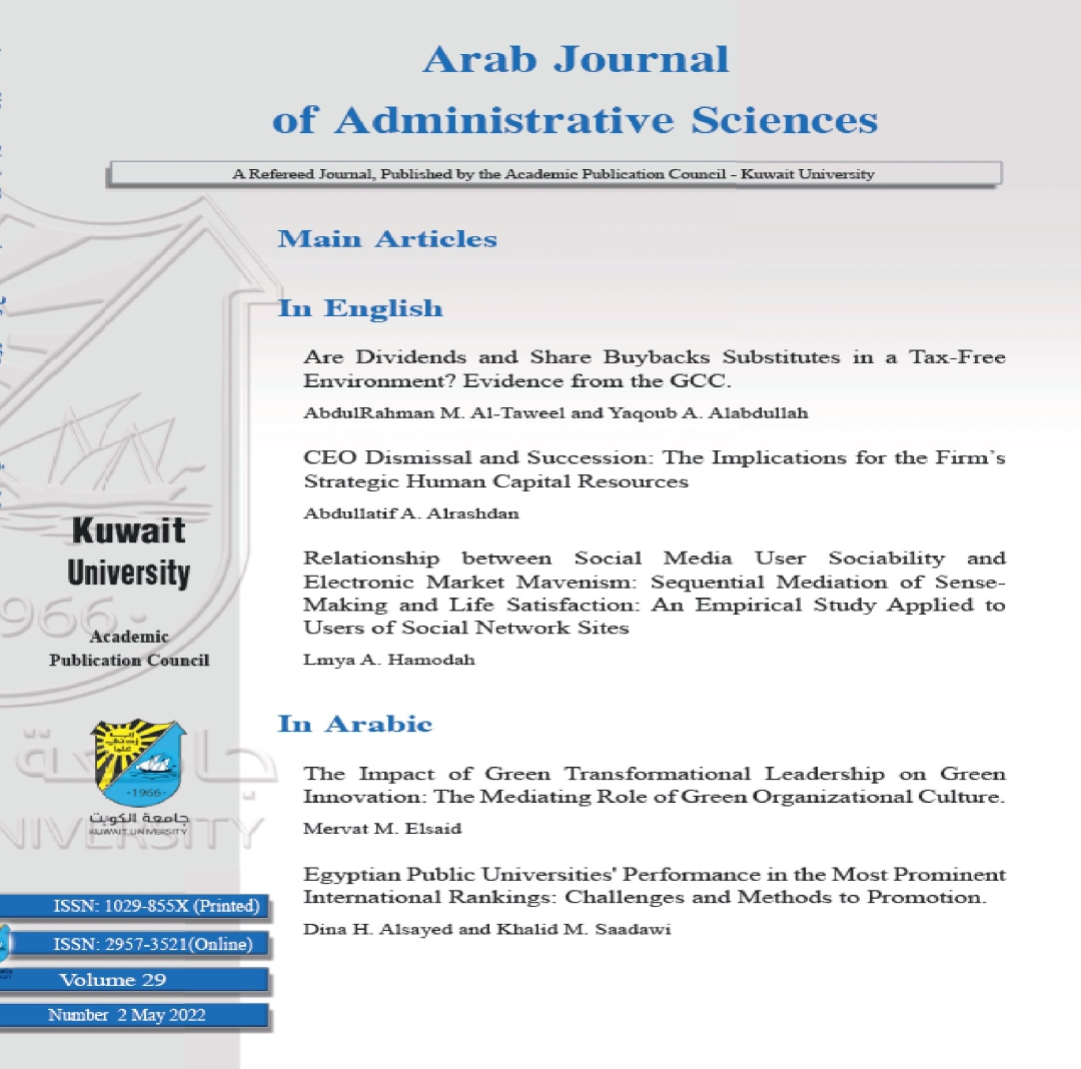
Egyptian Public Universities' Performance in the Most Prominent International Rankings: Challenges and Methods to Promotion
DOI:
https://doi.org/10.34120/ajas.v29i2.189Keywords:
Egyptian and Arab Universities Performance, THE, QS, ARWUAbstract
Purpose: The study aims to focus on the most influential rankings characteristics and determine the Egyptian public universities' position in those rankings by analyzing the indicators that cause a decline in their performance and comparing them with the Arab and international universities to suggest practical ways to upgrade their ranks.
Study design/ methodology/ approach: Cluster analysis is used to identify the Arab universities that have similar characteristics in their performance. Discriminant analysis is also used to determine the indicators of the lowest performance of Egyptian universities, which makes a significant difference between universities in Egypt and international universities, and to analyze what is behind the abstract numbers using the case study method in presenting reasons for the decline in the Egyptian universities’ performance.
Sample and data: The study uses a sample of 120 universities, i.e. the top 100 international universities and all 20 Egyptian universities to conduct cluster analysis, and all 47 Arab and Egyptian universities to perform discriminant analysis.
Results: The results show a decline that is caused by scientific research funding, the number of researchers, and specialists in the fields of Fields and Nobel Prizes, patent holders, citation and international publication, and internationalization and academic exchanges.
Originality/value: The study applies the quantitative analysis of Egyptian public universities’ position within the global and Arab environment to determine the indicators of the lowest performance of Egyptian universities and so propose the practical mechanisms that would improve the Egyptian universities’ reputation.
Research limitations/implications: The study conducts quantitative analysis only on THE, as the scarcity of Egyptian universities in ARWU and special QS rank for the Arab universities. The study also focuses on analyzing the performance of Egyptian universities up until 2019, shortly before the coronavirus pandemic avoiding its impact on the indicators of university performance.
Downloads
References
Aguinis, H., Cascio, W. F., & Ramani, R. S. (2017). Science’s reproducibility and replicability crisis: International business is not immune. Journal of International Business Studies, 48(6), 653-663.
Aguinis, H., & Cronin, M. A. (2022). It’s the Theory, Stupid. Organizational Psychology Review. https://doi.org/10.1177/20413866221080629
Aguinis, H., & Pierce, C. A. (2008). Enhancing the relevance of organizational behavior by embracing performance management research. Journal of Organizational Behavior: The International Journal of Industrial, Occupational and Organizational Psychology and Behavior, 29(1), 139-145.
Aguinis, H., Ramani, R. S., & Alabduljader, N. (2018). What you see is what you get? Enhancing methodological transparency in management research. Academy of Management Annals, 12(1), 83-110.
Aguinis, H., Ramani, R. S., Alabduljader, N., Bailey, J. R., & Lee, J. (2019). A pluralist conceptualization of scholarly impact in management education: Students as stakeholders. Academy of Management Learning & Education, 18(1), 11-42.
Aguinis, H., Shapiro, D. L., Antonacopoulou, E. P., & Cummings, T. G. (2014). Scholarly impact: A pluralist conceptualization. Academy of Management Learning & Education, 13(4), 623-639
Banks, G. C., Barnes, C. M., & Jiang, K. (2021). Changing the conversation on the science–practice gap: An adherence-based approach. Journal of Management, 47(6), 1347-1356.
Banks, G. C., Pollack, J. M., Bochantin, J. E., Kirkman, B. L., Whelpley, C. E., & O’Boyle, E. H. (2016). Management’s science–practice gap: A grand challenge for all stakeholders. Academy of Management Journal, 59(6), 2205-2231.
Banks, G. C., Rogelberg, S. G., Woznyj, H. M., Landis, R. S., & Rupp, D. E. (2016). Evidence on questionable research practices: The good, the bad, and the ugly. Journal of Business and Psychology, 31, 323-338.
Bansal, P., Bertels, S., Ewart, T., MacConnachie, P., & O'Brien, J. (2012). Bridging the research–practice gap. Academy of Management Perspectives, 26(1), 73-92
Beltran, J. R., Aguinis, H., Shuumarjav, Y., & Mercado, M. (2024). Putting Scholarly Impact in Context: Implications for Policymaking and Practice. Academy of Management Perspectives, doi: 10.5465/amp.2023.0198
Blake, J. (2024). Doubts About Value are Deterring College Enrollment. Inside Higher Ed.
Glick, W. H., Tsui, A., & Davis, G. F. (2018). The moral dilemma of business research. BizEd, 17(3), 32-38.
Kerr, S. (1975). On the folly of rewarding A, while hoping for B. Academy of Management journal, 18(4), 769-783.
Kim, P. H., Ployhart, R. E., & Gibson, C. B. (2018). Editors’ comments: Is organizational behavior overtheorized?. Academy of Management Review, 43(4), 541-545.
Nobel, C. (2016). Why isn't business research more relevant to business practitioners. Harvard Business School Working Knowledge, 19.
O’Boyle, E. H., Götz, M., & Zivic, D. C. (2024). Increasing the practical relevance of management research: In honor of Timothy T. Baldwin. Business Horizons, 67(2), 161-171.
Priem, R. L., & Rosenstein, J. (2000). Is organization theory obvious to practitioners? A test of one established theory. Organization Science, 11(5), 509–524.
Rynes, S. L., Bartunek, J. M., & Daft, R. L. (2001). Across the great divide: Knowledge creation and transfer between practitioners and academics. Academy of Management Journal, 44(2), 340–355.
Schiller, B. (2011). Academia strives for relevance. Financial Times, 25, 13.
Shapiro, D. L., Kirkman, B. L., & Courtney, H. G. 2007. Perceived causes and solutions of the translation problem in management research. Academy of Management Journal, 50(2), 249–266.
Schwab, A., Aguinis, H., Bamberger, P., Hodgkinson, G. P., Shapiro, D. L., Starbuck, W. H., & Tsui, A. S. (2023). How replication studies can improve doctoral student education. Journal of Management Scientific Reports, 1(1), 18-41.
Tucker, B., & Parker, L. (2017). In our ivory towers? The research-practice gap in management accounting. In The Societal Relevance of Management Accounting (pp. 32-71). Routledge.
Van Noorden, R. (2023). More than 10,000 research papers were retracted in 2023—a new record. Nature, 624(7992), 479-481.
Downloads
Published
How to Cite
Issue
Section
License
Copyright (c) 2023 Arab Journal of Administrative Sciences

This work is licensed under a Creative Commons Attribution-NonCommercial-NoDerivatives 4.0 International License.